
Author: Canon Dr. Josh R. Ritter
In November 2024, I wrote a post called What is a Micro-Formation? In that piece, I defined micro-formation as, “Any small reflective observation or intentional teaching on an aspect of Christian formation that connects directly to someone’s daily life and Christian practice.” I then suggested:
More powerful than programs, retreats, or events, we significantly undervalue the simple, intentional gestures of communication we offer to ourselves and to others. In fact, we often fail to realize that the small micro-formations we sow can have some of the biggest impacts in people’s lives.
In sum, micro-formations are the seeds Jesus told us about, and we might here recall his teachings on the powerful practice of seed casting to plant for future harvests. So, Jesus used micro-formations, and he practiced the art of seed casting. Why don’t we?
To continue reading about micro-formations, see my previous post.
Creating micro-formations of Holy Week
What is the one, simple micro-formation we can practice for Holy Week that can have a huge impact?
Generosity.
Practical love. Our highest quality of love that is available to us. Jesus tells us to love others as he loved us, with unconditional acceptance. This is generosity, and it is the way others will know we are HIS disciples. Because there are a lot of disciples of other things out there.
- Disciples of culture.
- Disciples of political parties.
- Disciples of pop stars.
- Disciples of movie stars.
- Disciples of athletes.
- Disciples of social media influencers.
How will people know we are Jesus’s disciples? Only by the quality with which we love others, and the highest quality of love out there is generosity.
Now, I don’t believe there is anything magical about Christianity. Jesus isn’t a wizard or a genie who grants wishes. God isn’t a magical Santa Claus. Discipleship and formation are not magical. But one thing that is kind of magical is generosity. It’s certainly contagious.
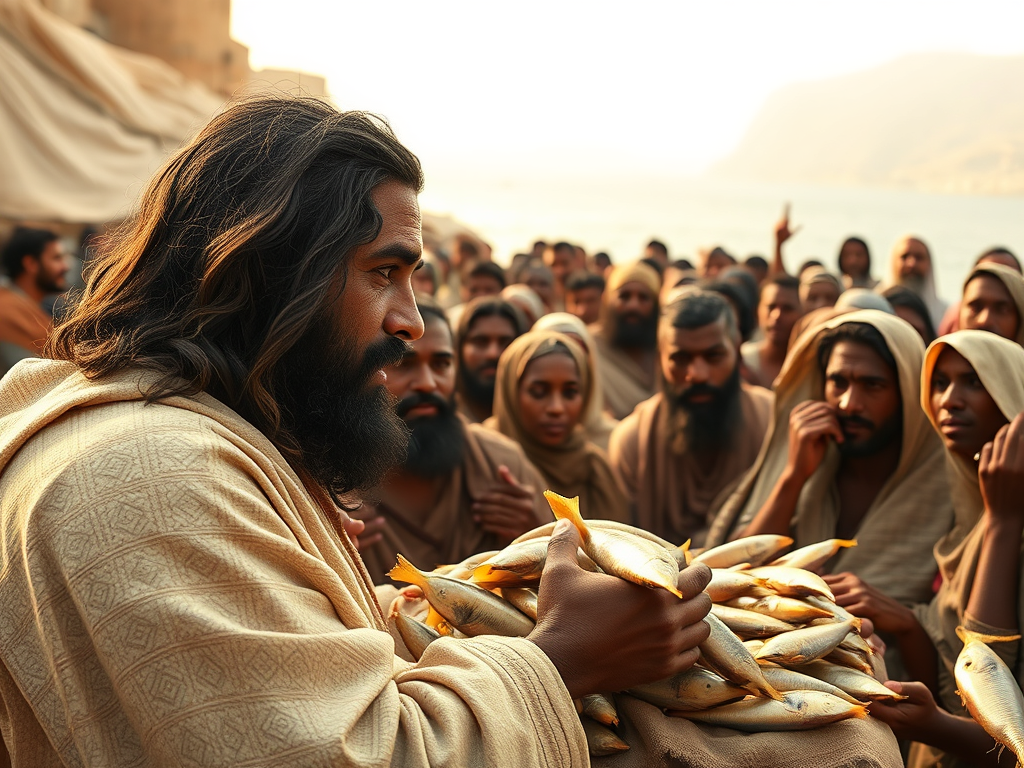
Jesus feeds the thousands (this is the picture AI created…fascinating, right?)
You remember this story? The story begins with a scarcity mentality – there’s not enough to go around. But Jesus says wait a minute. Let’s bless the food.
Here, Jesus imitates the prophet Elisha in 2 Kings who also feeds 100 people with 20 loaves. The people say, “There will not be enough,” but Elisha says, “Give it to them. I will bless it, and there will be more than enough for everyone.” That is what Jesus does here except he feeds thousands.
So Jesus says let’s bless what we have. It will be more than enough because we will be blessed by God’s generosity and the generosity God inspires in the hearts of our neighbors. Soon, everyone was sharing all they had, and there was more than enough. This is a miraculous story because anytime people are generous it is a miracle, and it is also contagious.
It’s hard to be generous.
Now, we may say, “No thanks. Our world is too insane. It’s too chaotic. Those people over there are too awful and hateful. I can’ be generous to them. I’m not like them, and thank God for that. They are beyond help. They are not true Christians. They do not practice or believe the way I do. They just don’t get it. Bless their hearts, if they only knew how wrong they are.” And, then, we walk around with a giant log in our own eye thinking we are so much better than “those people over there,” and we never think once that they might be just like us. We never think to ourselves, “Wow, I have this huge log in my own eye. I wonder if it’s distorting the way I interpret people around me?”
We never reflect on the fact that no one sees themselves as evil in their own narrative. We don’t see ourselves as evil or hateful in our own stories we tell about ourselves do we? No! We, of course, are the hero of our story!
But they are also the hero of their own story…they too believe they are right, just as we believe ourselves to be right. Generosity comes into this when we can put ourselves in our neighbor’s (enemy’s) shoes and can see ourselves in them, loving our neighbor as our own self. Generosity comes into play when we can practice the small micro-formation of “just like me.”
Just like me they are scared and looking for something to hold on to. Just like me they want to be right because being wrong is terrifying. Just like me they have bills to pay. Just like me they have family they care about, and just like me they do not see themselves as evil even though that is how I am mis-judging them.
Generosity is the antidote to all this insanity. Generosity is a practice of sanity. It is a counter-cultural practice because our consumer culture tells us not to be generous. It tells us every moment of every day to be stingy, rigid, gluttonous, avaricious. It tells us to hoard.
Consumer culture teaches us that we need more than we need. It forms us into the shape of infinite accumulation. Nothing is ever enough.
We come to believe, inhabit, and incarnate a life that is formed into the shape of living where there is no amount of money that is enough. There is no amount of food or stuff or even information that is ever enough. We always crave more.
This is why consumerism is not an economic problem. Consumerism is a spiritual problem.
In traditional Christian language, we have diagnosed this problem as gluttony or avarice, and there is a reason why these “sins” are given a prognosis of deadly…they deaden us and slowly suffocate our souls until there is nothing left.
Again, generosity is the antidote to this consumerist conditioning and programming. Generosity is not about hoarding. It is about letting go. We give it away. We empty ourselves out. We stop believing the lies of scarcity. We share with our neighbors. We forgive. We forgive first, we forgive always. This generous love is a Jesus-shaped love, and it is the way the world will know we are his and belong to his teachings, his Way.
Jesus’s teachings on emptying out and forgiveness are not an ideology, they are a piece of the Beatitude Path of Christian Maturity for how to live well and express the love of Christ to everyone we meet.
In the same way, his various Feeding Teachings (there are several times when Jesus feeds thousands within the gospels) are not economic frameworks for his advocacy of socialism, communism, or capitalism. It’s just generosity. A miracle. When the people of God practice generosity, people get fed (spiritually, emotionally, physically). It’s not magic. Generosity is contagious. It’s practical. It’s tangible. It flows from the heart of God into the hearts and souls of God’s people.
Is this not Jesus’s most basic teaching? He faced the insanity of the horrific death machine that Rome called crucifixion, and he transformed it into something beautiful that we call the Cross. He did this through generosity.
It is generosity that is the teaching of the Cross. Against all odds. Against the insanity of the world. Up against the worst violence and hatred that humanity could create, the shame of the crucifixion was transformed into the beauty of the Cross.
The cruciform life is the life of generosity, a Jesus-shaped life, revealing to us the path of salvation flowing down from the heartbeat of God and through the heartbeat of Christ…an incarnation of generosity…the beating heart and the rhythm of generosity.
Our doors are closed to no one. Our tables are open to all.

Generosity is the micro-formation we desperately need in our lives every day. The opening up to the world around us so that we come to seek and to serve Christ in everyone we meet. The opening up to all of Creation with a generous heart that does not crave more than we need. That does not fall into the trap of grasping for more than we need, no matter the cost, no matter who or what it destroys, deprives, or oppresses, but instead, hungers and thirsts for the well-being of all people and all of Creation.
Generosity is the healing work of salvation (salveo).
Is it not generosity that has saved us? God’s faithful generosity to God’s Creation? Is it not due to God’s generosity that any of us are born at all?
Who are we to witness the unfolding of this life and Creation? Who are we to take it for granted? Who are we to believe we have all the “right” answers and “they” have all the wrong ones? Who are we to put ourselves into the place of God?
We are made of nothing but generosity…gift and grace, and we must open our hearts as God’s heart is also always open, moving, and flowing with mercy and generosity.
It’s time to remind our folks about generosity. Just speak a small reminder of generosity into someone’s life today. Or, better yet, offer a small act of generosity today. Let’s turn our daily tasks into small acts of love. These are micro-formations.

Returning those emails are not tasks. Returning those emails are small acts of love and care that help people feel comforted, feel less anxious, feel less overwhelmed, get an answer they are waiting for, gain some direction or clarity they need. Returning those emails is generous and compassionate.
Being clear in our communication is generous. It’s not another task or empty gesture. Being clear is compassionate and reduces anxiety. Listening well and deeply to another person share their story, pain, or celebration is an act of generosity. Listening well to others ask questions is an act of generosity. Stopping ourselves from trying to be “right” all the time or “fix” things or convert others to our way of thinking about a particular topic or perspective is an act of generosity. This practice of communication is a micro-formation of generosity.
Buying someone a coffee is not a task or an obligation. Buying someone a coffee is a small act of love that opens up their heart even as it opens up ours. The more we give away, the more we receive. This is the paradoxical law of giving. It is a micro-formation, and this act of generosity puts out more compassion into the world and less stinginess. We don’t need more stinginess and hoarding in our world. We need small acts of generosity.
Sending someone a brief note is not a mindless task. Sending someone a note is a small act of kindness that sows the seeds of connection, relationship, and compassion. Reaching out to someone who needs to hear from us is a loving gesture. Speaking words of compassion, encouragement, and beauty into someone’s life today brings more joy into the world and less despair. We don’t need more despair and isolation in our world. We need small acts of generosity.
In these ways, you are co-creating narratives of meaning, narratives of purpose, rhythms of life, communal identities, social cohesion, and…perhaps most importantly…trust…in each other and in God.
Never underestimate the power of the micro-formation!
 Formation