
Author: Canon Dr. Josh R. Ritter
In November 2024, I wrote a post called What is a Micro-Formation? In that piece, I defined micro-formation as, “Any small reflective observation or intentional teaching on an aspect of Christian formation that connects directly to someone’s daily life and Christian practice.” I then suggested:
More powerful than programs, retreats, or events, we significantly undervalue the simple, intentional gestures of communication we offer to ourselves and to others. In fact, we often fail to realize that the small micro-formations we sow can have some of the biggest impacts in people’s lives.
In sum, micro-formations are the seeds Jesus told us about, and we might here recall his teachings on the powerful practice of seed casting to plant for future harvests. So, Jesus used micro-formations, and he practiced the art of seed casting. Why don’t we?
To continue reading about micro-formations, see my previous post.
Creating micro-formations of shifting mindsets
Have you ever wondered what Paul meant by putting on the mind of Christ or of living in and as the Body of Christ? I have to admit, it’s difficult for my individualist perspective to wrap my head around. It’s not an intuitively straightforward image for me, but for Paul and for those he was writing to, this would have been very clear.

So, before we figure out what a micro-formation of shifting mindsets looks like, let’s do a little contextual digging.
(If you’re too busy to read about context right now, this is your chance to skip down to the final section below!)
First, putting on the mind of someone (or imitating someone) who was an ideally Good person was very common in the Greco-Roman world, especially when it came to moral philosophers.
A key practice for them was to emulate someone in thought, word, and deed (just as Paul says in Col 3:17) who:
- Modeled civic virtue (arete)
- Willingly chose (prohairesis) to live a virtuous life (kalos kagathos)
- And persevered/endured in this virtuous lifestyle (hupomone), no matter what
- Following this ideal person would result in a shift of mindset (metanoia), a change in lifestyle, attitude, habits, and behaviors
Overall, it was a way to become (a type of metamorphosis or transformation) a morally virtuous person of high character, and it was taught, that those who achieve perfect virtue will live forever, eternally idealized in the minds and hearts of their disciples.
In Paul, we see him using all of these Greek terms/ideas, either explicitly or more subtly, and so, it seems that he wants us to put on the mind of Christ in this similar way so that we can become imitators of Christ and inheritors of God’s kingdom.
That is, he thinks that we will become a Jesus-shaped person in our speaking, in our thinking, and in our acting because the more we imitate his life and follow his teachings the more our old, selfish self, will die off and will be replaced only with Christ who lives in us (a new metamorphosis or transformation).
Second, at least since Plato, the Greeks spoke of society in terms of the body.
In Roman culture (closer to the time of Jesus and Paul), those such as Cicero spoke at length about Rome as the body, and they spoke mostly about the health of the body (the body politic). Actually, they usually talked about how unhealthy and diseased Rome had become!
Again, in like manner, Paul takes up this image for his own purposes and translates them into religious terms.
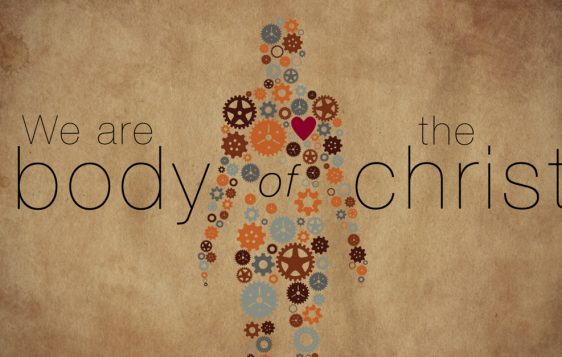
In the Body of Christ, there is no more male or female, slave or free person, Jew or Gentile. Each one of these pairs is a separate very bold statement that would have disturbed many people from all walks of life, religious and non-religious.
It was controversial because, normally, in speaking about Rome as the body, each part had a clearly defined purpose. Males and females had clear roles. Slaves had clear roles, etc, and no one crossed those boundaries. Certain moral philosophers, such as Cicero and Seneca, said it was okay to treat everyone well, but they still maintained that people needed to stay in their proper societal order. At various times, Roman culture was actually very focused on “traditional family values,” at least superficially, and the “proper” roles that everyone could play.
Paul, on the other hand, put traditional views of family and society into question. He crossed gender lines (male and female), socio-economic lines (slave and free person), and ethnic lines (Jew and Gentile).
Don’t get me wrong. Paul still had a lot of traditional ways of viewing some of these roles, but in terms of the rest of his culture, he was pretty radical. In particular, Greeks and Romans were obsessed with status related to social and economic standing, so this one was especially troubling for them. Paul also elevated the status of women and slaves in some ways that clashed with Greek, Roman, and Jewish cultures. Paul’s Jewish audience (but not all Jews) would have also been somewhat offended by his disregard for maintaining clear ethnic identities.
So, the Body of Christ that Paul was describing was a different type of inter-connected, communal understanding of the world where social norms were shifting and evolving. In many ways, it was a fairly radical way of reframing how people understood their place, role, and status within society as a whole, but the overall point I want to emphasize here is that Paul’s imagery is a highly communal, collectivist image. It is not an individualist image.
Third, Jesus’s and Paul’s culture was a communally oriented culture. In America, we are individualist rather than collectivist.

Yes, this is an over-generalization but…
In America, we don’t think in terms of “we.” We think in terms of “I.” This is a small distinction but a huge deal when it comes to how we read scripture.
Again, these are some over-generalizations but…
Individualists think in terms of “I,” independence, individual freedom (to do what I want when I want), and self-reliance. Collectivists think in terms of “we,” inter-dependence, freedom within a collective (what is best for the community), and reciprocity. Individualists are conditioned to believe, “I don’t need anyone but myself.” Collectivists are conditioned to believe, “We need each other,” we live in reciprocal relationships that are inter-dependent on one another and that is true freedom.

In all seriousness, both groups have their own problems, pitfalls, strengths, and weaknesses.
So, why is seeing the world through an individualist lens a problem?
Well, it’s not that individualism is inherently bad. The problem comes in because the entire biblical worldview is a collectivist one, and if we want to understand scripture with more depth, then we need to understand collectivist cultures with more depth.
The main idea to marinate on here is that dependence is a good thing. In individualist cultures, we are taught that being dependent on anything is not good. It often means we are weak in some way. We are taught to value independence and strength, but Jesus doesn’t actually teach independence.
He teaches dependence on God and inter-dependence on community. Indeed, the biblical stories tend to portray independence as a type of sin, an assertion of one’s own will above the will of God (basically saying we got this and don’t need God), which is a breaking with relationship from God and community.
Broken relationships are deeply troubling for collectivist cultures and, so, also for Jesus. Most of his teachings are actually about inter-dependence focusing on mending relationships or undermining social norms (like ethnic or religious prejudices) to create new relationships. In short, he is attempting to strengthen the bonds of “we,” not “I.”
Christianity uses a lot of “we” language and family language (brothers and sisters in Christ), but individualist cultures don’t really understand this language in the same ways a collective culture would understand them.
In an individualist society, for example, we tend to think of a community as being the sum of the individuals (their skills and talents), but in a collectivist culture, the individual is the sum of the community. The community characteristics, values, and identity all form the character of the individual. Not the other way around.

An individualist understanding of community is why we often misinterpret Paul’s image of the Body of Christ. We think that the better, more moral, more disciplined, more discipled, more spiritual the individuals we can create, the healthier the Body will be.
However, what Paul is telling us is that the opposite is true. It is the Body of Christ that forms and shapes us, not the other way around.
That means that it is not the sum of high quality parts that makes a healthy Body but the enhancement of the relationships among the parts that makes a healthy Body.
For example, when Jesus teaches us to pray as “Our Father,” individualists focus on the way that God is my Father in Heaven. We just glide right over the “our” as a collective reality, and we want God’s will for my life. Collectivists, on the hand, focus on the way God is our Father in Heaven and what God’s will for us might be. This is about the relationships among us and how we as a collective relate to God together.
For a collectivist, what I do or do not do is not just about my own life because my actions are a direct reflection of the larger group. We are responsible for each other.
Thinking back to the body imagery in Greco-Roman culture and in Paul, Plato said that the individual soul is a reflection of the soul of Athens (the larger citizenry). Likewise, many moral philosophers worried about individual sin (as a disease needing to be healed) because it reflected the health or diseased state of the larger body (for example, Rome). The emphasis is always on the larger group.
More tangibly, for a collectivist culture, the “we” is about family and extensions of the family through social networks.
What family you belong to is a really big deal. Your lineage matters, which is why scripture often offers us lists of lineages. This is because simply naming a person doesn’t mean much in a collectivist culture. It doesn’t mean much that “I” am “Josh.” What does matter is the family I belong to.
When Jesus says, “Who do you say I am?” (Matt 16:15), he doesn’t want to hear the answer, “You are Yeshua” (which is Jesus’s name in Hebrew). Instead, the answer he accepts from Simon is the identity given to him by the larger group, “the Messiah,” which is also a collectivist identity in the sense that its importance is based on the value it is given by the larger group (not to mention an impressive lineage of prophets). It is a communal (family) name.
To emphasize the point, he then renames Simon as Peter as a gesture of Simon finally “getting it” in terms of Jesus’s discipleship program. That is, Simon just graduated to the next level, but why rename Simon as Peter (“rock”)?
This Rock?

NO! This rock…

In Greek, petros is a common noun that means “rock,” but the important part of the story for a collectivist comes only when Jesus says, “On this rock I will build my church.” This is a promise of a new family with a new lineage and the equivalent of God telling Abraham to leave his current family (which is unthinkable to collectivist cultures) to go start a new one with a new lineage so that his descendants will be as numerous as the stars in the sky (Gen 26:4).
In collective societies, individual names are not as important as collective identities, and the promise for Simon is one of a really impressive new family and new lineage. Simon does not protest the renaming, so we can assume he accepted it as an honor.
This story makes a little more sense in light of another teaching several chapters earlier when Jesus says, “Who is my mother, and who are my brothers?” Pointing to his disciples, he said, “Here are my mother and my brothers. For whoever does the will of my Father in heaven is my brother and sister and mother” (Matt 12:48-50).
Here, Jesus is telling us about a new family we are joining, “born again” into this new family (Jn 3). Forget about simply being neighbors, fellow disciples are family! In this sense, Simon is born again as Peter, and he now has a new family with a new lineage.
For Paul, the focus on the Body of Christ is also about a “we.” We are now a family, and he uses a lot of familial language. He specifically says we are all adopted into the Body of Christ, we are all one in Christ Jesus. This is a gift, a grace (karis), says Paul, and gifts in the ancient world had strings attached. But they are good strings because they are strings that bind people together in relationship.

In the ancient world, the point of the gift is not the gift itself. We individualists tend to miss the point on this. For example, sometimes Christians focus on Christ as a gift as the main part of Christianity, and when we do, we miss the deeper theological point that the gift is meant to bring us into a relationship with God and Creation. The gift of Christ allows us to enter into a relationship and a kinship within the Body of Christ, our new family.
For a collectivist, this is surprising language because this means we are leaving one family and joining another one. More than this, it means we are becoming (transforming into) another one. For a collectivist, this is a big deal. For an individualist, we may just miss the point of how life altering this may be.
Okay, okay, okay…what’s the point of all this?? Where is the micro-formation in all of this?
So, let’s mash all of this together.
Now that we have a deeper understanding of some context, what is Body of Christ thinking?
Well, very simply, it’s “we” thinking. Paul says, “We belong to each other” (Rom 12:5). And now we (individualists) understand a little more deeply what that means within our biblical stories.

Why is this so important?
First, Jesus’s and Paul’s message to us is a message of We. Paul’s main image of the Body of Christ that he uses repeatedly is a collectivist, familial image, but individualist readers of scripture today don’t usually fully understand what all this We-ness is about because we see the world primarily through the lens of “I.”
So, shifting people’s perspectives in our communities towards a more We-oriented biblical understanding of reality is really important for how we teach them to approach and relate to scripture.
This is, of course, not true for all of our communities. Latino/Latina, Hispanic, Asian, Asian-American, Southeast Asian, African, and African-American church communities tend to see the world through the lens of “we.” So, individualists can learn A LOT from our collectivist brothers and sisters in Christ.
Second, this shift in mindsets will not happen quickly. There is no program or magic curriculum that will solve this issue in our churches and communities. What we need is the persistent, consistent, long-term power of the micro-formation. Yes, it is going to be SLOW and difficult because our individualist society conditions us to see the world through the lens of “I,” but in the long run, it will definitely be worth the effort.
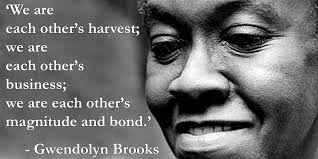
Slowly but surely, it is our job as formation leaders to bring “we” language into our communities. In all that we do, in our speaking, in our thinking, and in our acting (Col 3:17), we are invited to practice our lives as and through Christ, and Christ’s mindset is a mindset of “we.”
Remember, micro-formations are NOT about starting new things, programs, events, or curriculum. Micro-formations are NOT about more work for you.
Micro-formations are about actively pursuing and seeking the opportune moments (kairos moments) in people’s lives to offer small, tiny shifts in their perspectives about God and their lives. Small, intentional observations. Small teachings. Small discernments. Small encouragements. Small celebrations. Small changes in our language that bring future harvests of massive shifts and transformations.

And don’t underestimate small changes in language. The language we use shapes us into who we become. As Jesus says, it’s not what goes into our mouths that defile and distort our lives. It’s our words. The words we speak come from our heart. They are a direct reflection of who we are and what is in our heart (Matt 15:11-20). In other words, Jesus says, the language we use reveals our true priorities, motives, and intentions.
Words shape us and define us, and definitions create realities. Words are important, and the language we use with our communities is important. Our words are the small seeds we plant in our heart and in the hearts of others that grow into future harvests.
This is why Paul tells us speak only as Christ speaks (Col 3:17) and to communicate only with love and compassion (1 Cor 13). It’s also why the entire letter of James is about communication and the ways we use and misuse language.
Communication is a spiritual practice!
What creative micro-formations can you use to begin shifting the language in your context and programs?
Can you, as clergy and lay formation leaders:
- Bring We language into lesson plans or sermons?
- Bring it into newsletters and bulletins?
- Bring it into Sunday morning announcements?
- Bring it into mission statements or highlight it in mission statements where it’s already present?
- Consistently mention your church’s participation in the larger city, area, region, or diocese?
- Highlight liturgical language that focuses on We-ness?
- Focus on relational models of discipleship and nurture more inter-relationships among your communities?
Over time, I promise that shifting your language will shift your mindsets. It will change your culture, and it will transform lives.
In these ways, you are co-creating narratives of meaning, narratives of purpose, rhythms of life, communal identities, social cohesion, and…perhaps most importantly…trust…in each other and in God.
Never underestimate the power of the micro-formation!
 Formation