
Author: Canon Dr. Josh R. Ritter
In November 2024, I wrote a post called What is a Micro-Formation? In that piece, I defined micro-formation as, “Any small reflective observation or intentional teaching on an aspect of Christian formation that connects directly to someone’s daily life and Christian practice.” I then suggested:
More powerful than programs, retreats, or events, we significantly undervalue the simple, intentional gestures of communication we offer to ourselves and to others. In fact, we often fail to realize that the small micro-formations we sow can have some of the biggest impacts in people’s lives.
In sum, micro-formations are the seeds Jesus told us about, and we might here recall his teachings on the powerful practice of seed casting to plant for future harvests. So, Jesus used micro-formations, and he practiced the art of seed casting. Why don’t we?
Perhaps we don’t think we have the time for all this planting of seeds. I mean, it is really time-consuming to build relationships and also pay attention enough to someone else’s life that we can communicate a meaningful, non-judgmental, encouraging/challenging observation into their life.
We, of course, all feel like time (kronos: linear time) is one of our biggest issues today. We feel that time is slipping away from us, that we don’t have enough time, that we need to manage our time better, that we wish others would give us more of their time. We are dominated by time, the cult of busy-ness, and the tyranny of the urgent.
The nice thing about micro-formations is that they can happen at any time because every moment is a formation moment (kairos: the opportune moment, the time of God). All moments are saturated with the presence of God and the movement of God’s Spirit (Mk 1:15). So, we can be creative and use our spiritual imaginations to think of new ways to bring micro-formations into our ministries and congregational life.
Remember, micro-formations are not programs. There is not some new curriculum to follow. There is no training you must do. There is no retreat you must attend. Micro-formations are the intentional ways we come to participate with God in the ordinary moments of our community’s lives.
You don’t need to try and find extra times to set up spaces for micro-formations. These are not intended to be extra work for you. Micro-formations are small, intentional gestures of speaking meaning into people’s lives through words of affirmation, appreciation, and discernment or through invitations into (small) shared practices of spiritual growth. They are integrated into what you are already doing. They foster growth and resilience because they are focused on relational engagement instead of transactional information exchange.
Along these lines, I want to offer an idea for a micro-formation during Lent, and it is focused on the sacred practice of listening.
For years, communication scholars have told us that 85-95% of communication is listening. And still we just keep talking at each other. Paul tells us in 1 Cor. 13 that listening and infusing our words with compassion and love is true communication. And still we just keep talking at each other, like a banging gong, bringing more noise into the world.
When we, as formation leaders, listen…we give voice to those around us. When we listen with wonder, appreciation, and curiosity, our people develop and clarify their faith and discipleship is deepened. Listening empowers the one we are listening to, and it transforms the listener.
God is the ultimate listener who models meaningful listening for and with us, and as we listen, we move into the heartbeat of God. When we truly listen to others, it is Christ who listens through us and transforms the encounter through the work of God’s Spirit.
Listening is how our congregations come to participate with us in the co-creation of our communities. Listening is how we learn, grow, and question together.
So, what can we do to listen more deeply by integrating micro-formations into the practices and ministries we are already doing?
Creating a Prayer Wall in your church or community space
Prayer is our most important posture as Christians. Each time we pray, we practice availability, and God uses this availability in our lives to plant seeds for a future harvest. Today, we sometimes forget that prayer is our direct connection with God.
As Jesus reminds us, the human soul fades and its fire grows dim when it is disconnected from its source of life, its Vine. This is not an abstraction. It is a practical teaching of Jesus. We see it all around us every moment of every day in the lives of our congregations and in the lives of our communities. We see it in the mirror as well.
As formation leaders, if we want to form others into re-connection with the source of life, then we must practice our connection to the Vine and the ocean of God’s love. This practice is called prayer.
Prayer is our attachment and our commitment, our fidelity, to the Holy. Prayer reminds us that our pursuits of goodness, truth, and beauty are meaningless unless they are leading us towards the Holy. And so, we know in our depths that prayer is life, and that means that practicing prayer with our communities is vital for a healthy Christian community.
One way to do this is to create a Prayer Wall, which is simple and easy to do, and it is usually also free. You can invite people to share their prayers anonymously or not. Put the prayer wall in a high traffic area in your space, and keep it open for all ages to participate. If you don’t have a physical space, create a digital one.
The key to this micro-formation is that you are offering people a time when and a space where they can choose to go and share a prayer for their life, for the community, or for the world in a tangible way (on a card, ribbon, piece of paper, post-it note, or in a digital space).
When you introduce the Prayer Wall to the community, be sure to use the brief intro as another micro-formation moment. Mention the various kinds of Christian prayer so they know their options, for example, a celebration, a praise, a thanksgiving, a petition, or a lament. Or they can offer a meaningful question about faith they’ve been struggling with and don’t know how to address it.
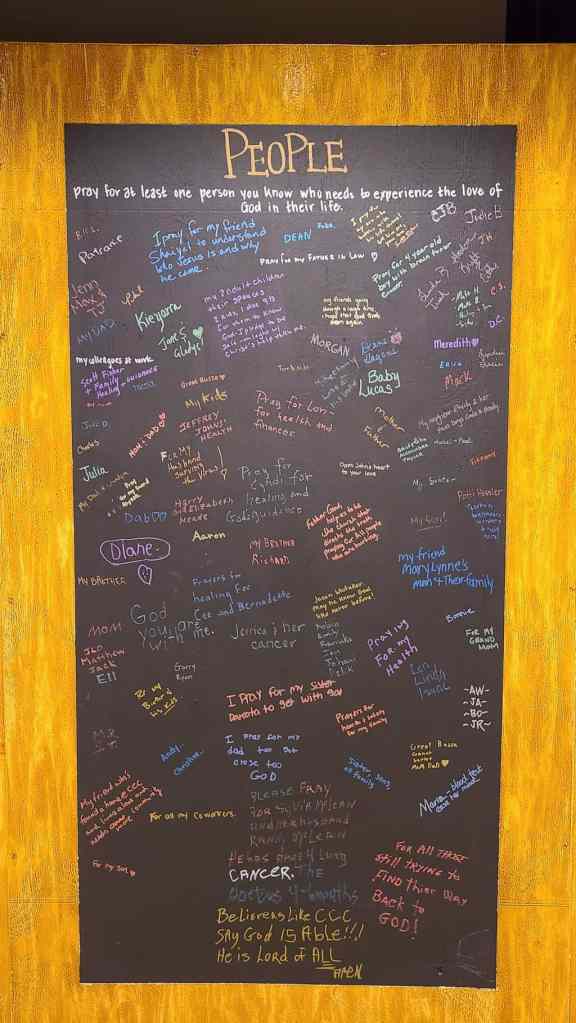
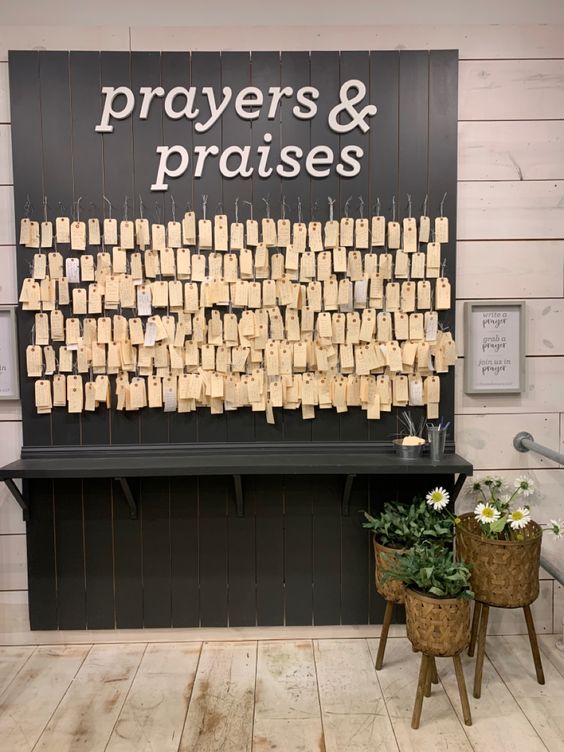

These are micro-formations of prayer because they are micro-teachings about prayer, and they are also small opportunities to pray, individually and in community together.
Remember, your are not rolling out a new program here. This is just a small but intentional communal invitation into a practice of prayer that is also a practice of community storysharing, and it is a way for people to actively participate in the co-creation of how their religious beliefs and ideas – their stories – fit into their daily lives. It is also a way to let everyone know that their community is listening to them and their hopes, dreams, desires, and concerns.
That’s why the Prayer Wall is also a micro-formation of listening. It is a sacred act to listen and to give voice to our community stories. It is a sacred time when we invite others to share their deep questions in a non-judgmental space.
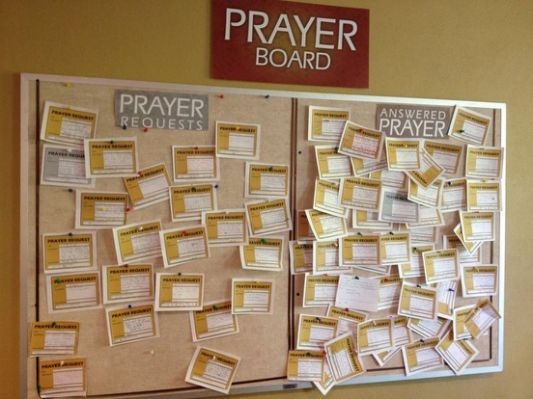


How do we build a prayer wall?
Provide clear communication and signage about the wall’s purpose within your community, and then…
- You could invite people to write a prayer on a sticky note and post it to a designated area.
- You could build a wall with hooks on it so people could write their prayers on a card with a thread attached and hang it on the wall.
- You could invite people to write their prayers on a long piece of cloth so they can tie it to the wall.
- You could invite people to write their prayers on index cards and have them put those cards into pockets on a posterboard.
- You could also simply offer a whiteboard or chalkboard where people could share their prayers and questions.
There are many ways to create a Prayer Wall. Be creative!

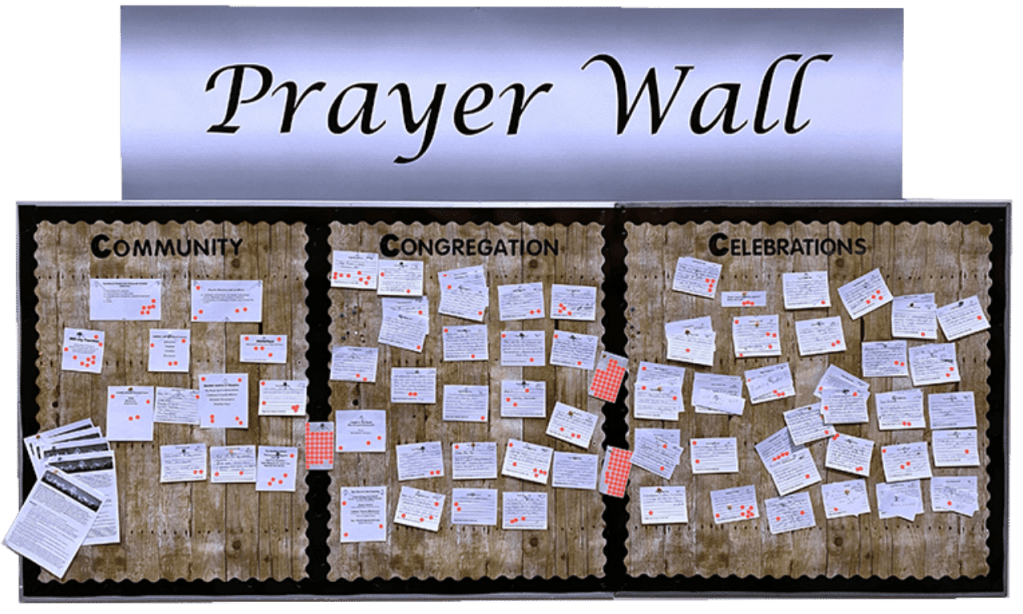
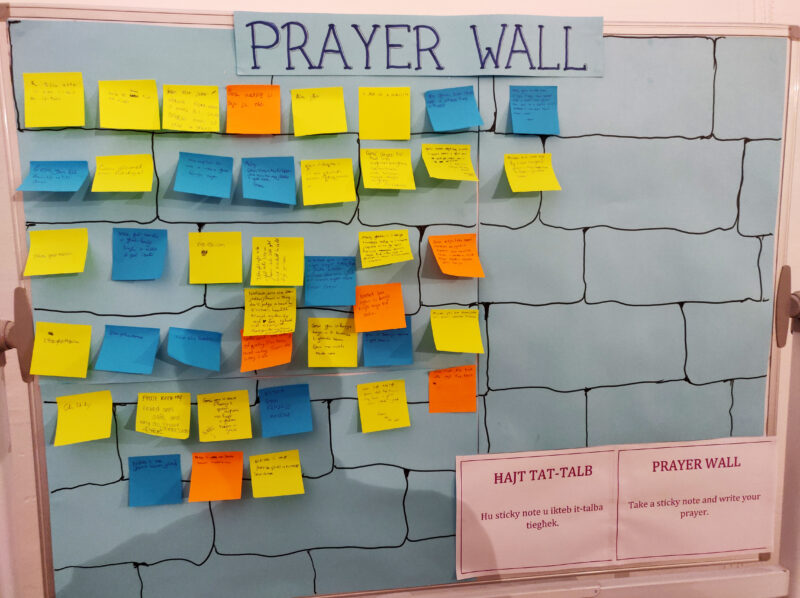
Now that you have all these prayers, it’s time to gather. Just look at all these prayers and questions you have to nurture and develop multi-generational community conversations!
Or, don’t gather. It’s up to you. If you don’t gather, you now have prayers and questions directly from your community telling you what is important and vital to them and to their lives. As a formation leader, perhaps you could find ways to weave these stories into sermons, formation lessons, or even conversations.
If you do decide to gather, no need to find some new time to get together. Just gather at a time you would normally get together. Maybe it’s during a Sunday Formation time, but maybe it’s not.
Whenever you decide to gather, don’t divide into age groups. Keep it inter-generational. You and your community are listening to people’s stories and connecting and weaving those stories together into the Big Story of God’s beloved community.
Don’t forget to ask good questions of appreciation and curiosity together and offer encouragement to each other. And listen well. You are co-creating the ways people are integrating their faith and doctrines into their daily lives. It’s all very exciting!
In these ways, you are co-creating narratives of meaning, narratives of purpose, rhythms of life, communal identities, social cohesion, and…perhaps most importantly…trust…in each other and in God.
Never underestimate the power of the micro-formation!
 Formation