
The Church at a Crossroads: Lessons from Six Years of Innovation
Why it matters: As we mark the sixth anniversary of TryTank Research Institute, a sobering reality confronts American Christianity: the strategies that propelled church growth in the 1950s and 1980s have lost their efficacy in our rapidly evolving social landscape. This isn’t merely about declining numbers – it’s about a fundamental shift in how society engages with religious institutions.
The challenge before us is multifaceted and more complex than many church leaders want to admit.
- We’re witnessing a perfect storm: rising secularism colliding with institutional distrust, compounded by the long shadow of sexual abuse and other scandals that have tainted religious institutions broadly.
- The temptation is to search for a “silver bullet,” one magical solution that will reverse the decline.
- Let me be clear: it doesn’t exist.
Yet amid these challenges, our work at TryTank has revealed promising pathways forward.
The congregations showing vitality – even growth – during these turbulent times share several distinct characteristics.
First and foremost is their commitment to robust faith formation.
- These churches aren’t retreating from spiritual development; they’re doubling down on it, creating more profound, demanding and, meaningful engagement with traditions and texts.
Second, and not surprisingly, we’ve found that community organizing principles are still proving effective.
- The most resilient congregations have become integral to their broader communities, not through presumption but through humble inquiry.
- They’re literally walking their neighborhoods, asking residents how the church can serve them.
- This outward-facing stance represents a profound shift from previous decades’s “build it and they will come” mentality.
But our most significant insight comes from the “abundance principle.” Too many churches operate from a scarcity mindset, focusing on what they lack.
- But not the vibrant ones—even if they are tiny.
- At TryTank, our foundational principle is that God has provided everything needed for ministry. The challenge is to recognize these resources in their contextual forms.
What’s next: we’re on the cusp of releasing groundbreaking research we undertook with our ecumenical partners on young adult parents and their relationship with religious institutions.
- This demographic holds crucial keys to the church’s future, and our findings will offer actionable insights for engagement.
This year, our ecumenical collaboration will consider patterns in lay-led congregations, potentially reshaping our understanding of leadership models.
The bottom line: The landscape of American Christianity is undoubtedly changing, but change doesn’t equal death.
- Or rather, it doesn’t have to.
- It demands adaptation, innovation, and, most importantly, the courage to face reality without losing hope.
- The good news remains good – our challenge is finding new ways to share it in a world increasingly skeptical of traditional religious expressions.
As we continue our work in our focus areas of faith formation, Latino ministry, and artificial intelligence, one thing becomes clear: the church’s future won’t look like its past.
- And that’s as it should be.
- The question isn’t whether God is still at work – it’s whether we’re prepared to recognize and respond to that work in its new and unexpected forms.
This is our moment of reckoning.
- Will we cling to outdated methods that once served us well, or will we have the courage to embrace new possibilities while holding fast to timeless truths?
- The answer to that question may well determine the future of American Christianity.
Strengthen Your Easter Outreach: Free Expert Guidance

Are you looking to grow your congregation and deepen spiritual connections this Easter season?
Rev. Ken Kroohs, an experienced church growth consultant, is offering free strategic guidance to help congregations maximize their pre-Lenten outreach efforts.
Through two 90-minute webinars, Rev. Kroohs shares proven strategies that have helped over 100 churches nationwide enhance their Easter engagement and long-term membership growth.
- The program includes personalized support before and after the sessions, with all materials available for future reference.
What’s next: The webinars are scheduled for January 21st and 28th, with flexible timing options at 11 AM or 7 PM Eastern. Churches are encouraged to register multiple team members to maximize impact.
So, are you ready to strengthen your congregation’s outreach? Register now for this free opportunity to transform your Easter ministry.
- The bottom line: Success stories from participating churches demonstrate the program’s effectiveness in building lasting connections. (Read some case studies here.)
Contact Rev. Ken Kroohs to secure your spot today.
Dispatches from the Future (of Faith): Listen!

In 2024, with the help of TryTank and a coalition of national partners, we undertook our first study at Future of Faith to better understand the connection between listening and faith formation.
In a world that trusts institutions and leaders less than ever, we were curious to dig into the one thing people said they did trust: personal relationships.
- The full results will be released in the coming months, but the initial findings have been astonishing.
By the numbers: Consider these top-level outcomes of listening just for the teenagers in our study:
- 90% of teenagers agreed that when someone takes the time to listen to them attentively, it makes them more likely to engage with that person in meaningful conversations in the future
- 77% agreed that when someone listens without judgment, the teenager feels more connected to that person
- 75% said that when they feel listened to in a conversation about faith or spirituality, it makes them more likely to be open about those topics in the future
- 77% indicated that being listened to helps them process spiritual challenges like doubt, disillusionment, and grief
- 66% agree that being heard deepens their faith
Why it matters: In our modern, low-trust world, listening is the ONE thing that changes EVERYthing.
(by Josh Packard, PhD, Future of Faith)
Living Stories: Transforming Sermons into Shared Experiences
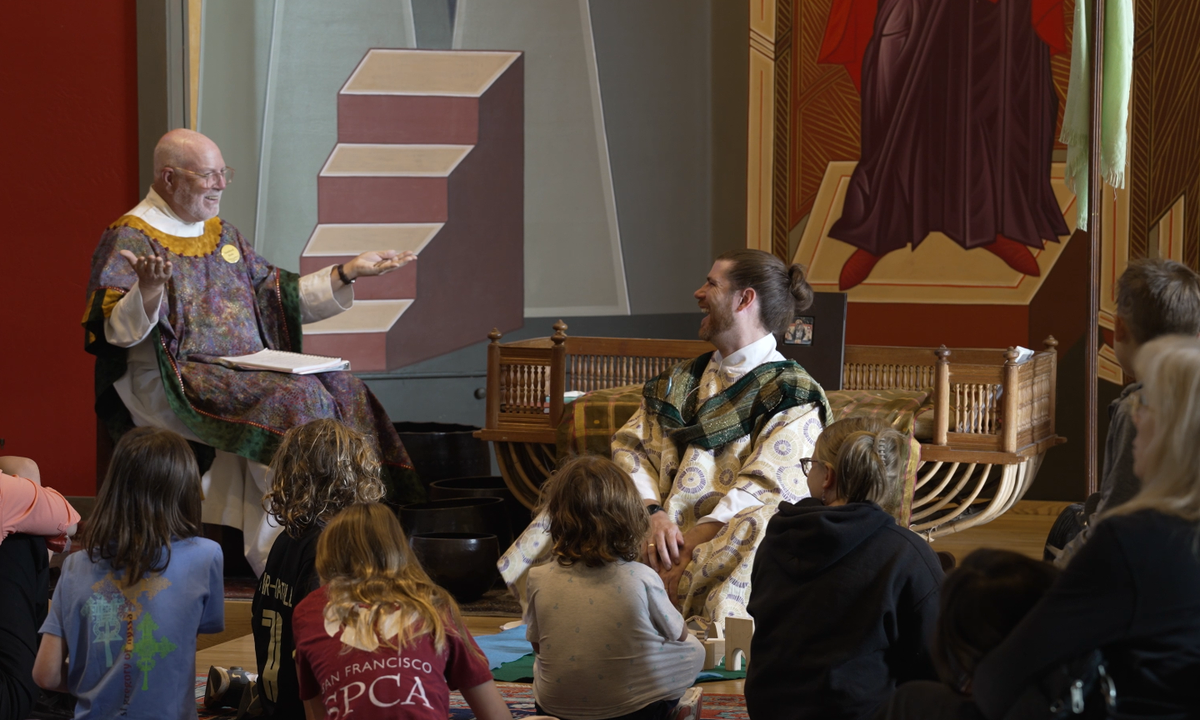
What if Sunday sermons weren’t just heard but seen, felt, and co-created by everyone in the room?
- Living Stories is an innovative approach to preaching that invites the whole congregation—kids and adults alike—into a shared exploration of scripture.
Go deeper: Rooted in the lectionary and inspired by Godly Play, Living Stories blends storytelling, tactile elements, and open-ended wondering questions to make the Gospel come alive.
- Instead of a single preacher delivering a message, the congregation becomes active participants, discovering meaning together.
- A parable might unfold with wooden figures on a felt underlay, sparking reflections like, “I wonder what this story says about our lives today?”
Why it matters: This emerging model fosters intergenerational connection, deepens spiritual engagement, and cultivates a sense of belonging through sacred storytelling.
- Curious to learn more? Join us for a free Zoom webinar and discover how Living Stories can transform your worship. Sign up today!
(by Rev. Peter Levenstrong, founder of Living Stories)
Episcopal Latino Ministry Course: Building Bridges for Tomorrow’s Church

The Episcopal Church’s 2025 Latino Ministry Competency courses offer a transformative opportunity for clergy and lay leaders to develop essential skills for serving our increasingly diverse communities.
- Sessions are scheduled in January (Virginia) and August (Atlanta/Sewanee).
- These intensive programs go far beyond language training.
Go deeper: Led by the Rev. Canon Anthony Guillén, the Church’s missioner for Latino/Hispanic Ministries, participants will explore crucial aspects of Latino/Hispanic ministry.
- This includes immigration, pastoral care, generational differences, and effective dual-language ministry approaches.
- The program recognizes that two-thirds of Latinos in the US are bilingual or English-dominant, preparing leaders for this demographic reality.
By the numbers: In-person training costs $1,600-$2,000, with virtual options available at $300. Space is still available for the January 18-24 session at VTS in Alexandria, VA.
Don’t miss this opportunity to strengthen your ministry skills for our multicultural future. Register now. More information.
 Formation